Cross Tarot Spread: How to Do It Step by Step
Four cards laid out in a cross plus a fifth one you work out in your head, for an answer far subtler than a plain yes or no
The cross spread is the one your aunt used to do, the aunt who "reads cards". A kitchen table, a well-worn deck, four cards laid out in a cross and a fifth in the middle that she works out in her head while you wait.
Plenty of people have watched it once and never figured out where that last card came from. Let's take it from the top. By the end of this article you'll be able to lay out a cross spread on your own and read it without a guidebook on your lap, math included.
What the cross tarot spread is for
It's a spread for one specific question with something at stake. Not for "what does this year hold for me", it's too narrow for that. And not for "will he text me tonight", it has far too much depth for that.
It shines when you're torn. A job in another city, a relationship stuck in neutral. The cross puts what supports you face to face with what holds you back, then shows how the situation might resolve.
Traditionally it's done with the 22 Major Arcana of the Tarot de Marseille. Some readers use the full deck, but the synthesis card only works with the Majors, since they're the only cards numbered 1 to 21.
How to lay out the cross spread
Shuffle the 22 Majors while you think about your question. Put it into one sentence, out loud if that helps. Then draw four cards, one at a time, and place them in this order:
- Left: what's working for you. Your strengths, the energy you can count on.
- Right: what's working against you. The obstacle, whether it's a fear or a person standing in the way.
- Top: what will decide it. Some call this card "the judge": the factor that tips the scales.
- Bottom: the outcome. Where things are heading if nothing changes in the way you act.
The fifth card, in the center, isn't drawn. It's calculated.
There are variations. In some schools the top card is the outcome and the bottom one is advice. Pick one version and stick with it: what matters is that your reading stays consistent from one spread to the next.
How to calculate the synthesis card
This is the part that scares people off, yet it comes down to two steps.
Add up the numbers of the four cards. Every Major Arcana card has its Roman numeral at the top.
If the total is over 22, add its digits together. 40 becomes 4 + 0 = 4, so The Emperor. 61 becomes 6 + 1 = 7, The Chariot. If you land on a number between 1 and 22, that's your card.
Two traps nobody warns you about.
The Fool has no number in the Marseille deck. Most readers count it as 22 in the calculation, others as 0. Decide once and for all. And if the synthesis comes out as 22, The Fool takes the center.
The second trap is sneakier: the numbering isn't the same everywhere. In the Tarot de Marseille, Justice is VIII and Strength is XI. In the Rider-Waite deck it's the other way round. Mix the two systems and your synthesis will be wrong. Use the numbers on the deck in your hands.
The synthesis card isn't a fifth opinion. It sums the situation up, like the moral of a story told in four pictures. You don't need to find it in the deck: knowing its meaning is enough.
How to read the four positions
Always look at the cross as a whole before getting into detail. Lots of figures facing left, toward the past? Very bright cards on one side and very dark ones on the other? That first glance is often worth as much as the card-by-card reading.
Then read across: for versus against. If The Empress sits on the left and The Tower on the right, you have the resources, but something abrupt threatens the plan. If The Hermit is on the left, your strength lies precisely in stepping back and not answering right away.
Next, the vertical line: the judge and the outcome. The top card tells you what will really settle things. With Wheel of Fortune at the top, an outside factor you don't control will play a part, like a deadline or a company decision. With The Lovers, your own choice is what counts.
Finally, the synthesis. It confirms or adds nuance. A hard outcome with a bright synthesis card, say The Sun in the center, means the road will be rough, but the whole thing will do you good.
A full cross spread example
Emma's question: "Should I take the job I've been offered in Manchester?" She has lived in London for ten years, and her partner isn't sure he'll follow.
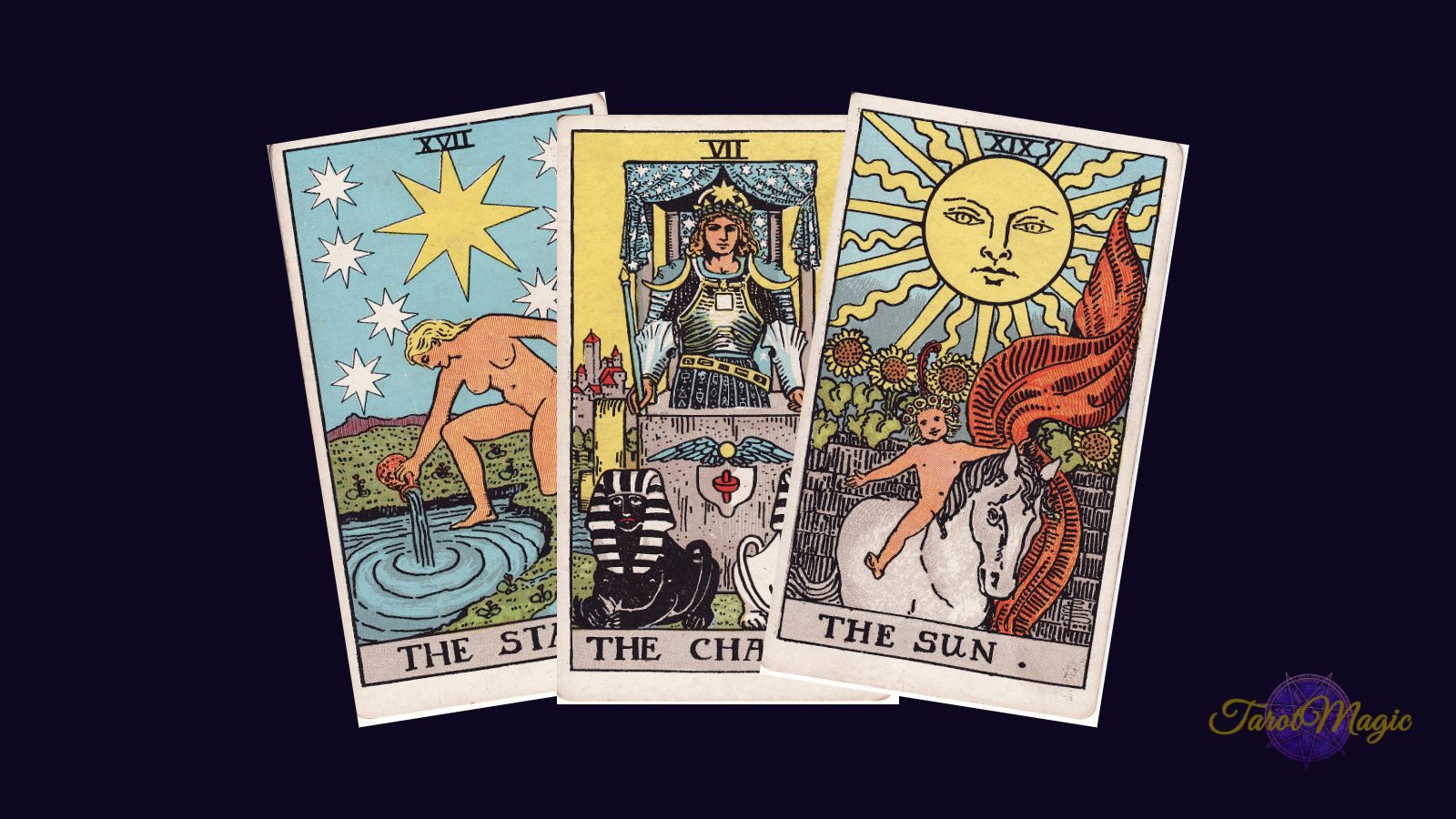
Left, what's working for her: The Star (XVII). A naked woman pours water under a starry sky. Hope, a fresh start. Emma really wants this move, and that desire is her real strength.
Right, what's working against her: The Moon (XVIII). Two dogs howl, a crayfish crawls out of the water. Fog, fears she can't quite name. What's holding her back isn't a hard fact, it's what she imagines: "what if he doesn't come", "what if I regret it".
Top, what will decide it: The Chariot (VII). A driver on his chariot, moving forward. The decision will come through action, not thinking. As long as she keeps weighing pros and cons in circles, nothing moves.
Bottom, the outcome: The Sun (XIX). Two children under a big sun. A clear, warm outcome, often tied to a couple who get along.
Synthesis: 17 + 18 + 7 + 19 = 61, then 6 + 1 = 7. The Chariot, again.
When the synthesis card repeats one that's already on the table, the spread is insisting. Here the message couldn't be plainer: move. This is how we read the cross. The Moon's fears are real but blurry, and the only way to clear them is to act. The Sun as the outcome suggests the couple can come out of this stronger, as long as they talk it through openly instead of Emma deciding alone in her head.
Emma had that conversation the same evening. Her partner asked for three months to arrange his own move. The tarot didn't decide for her: it showed her that her real block was a fear, not an obstacle.
Cross spread online: the quick version
No Marseille deck at hand? Our three-card reading uses the full Rider-Waite deck, and it doesn't lay out a cross. But you can keep its spirit with your own reading scheme. The first card shows what's working for you, the second what's working against you. The third becomes the likely outcome, and you quietly give it the judge's role too.
You lose the synthesis calculation, since the draw mixes Majors and Minors. In return, the Minor cards bring concrete details, a contract in Pentacles or an argument in Swords. The site shows each card with its meaning, and linking them with this scheme is up to you. The paid interpretation reads the three cards together as one story, without these positions.
For a closed question, the yes or no tarot is more direct.
Classic mistakes
- Asking a vague question. "What about my love life?" gives nothing readable in a cross. "Should I give this relationship another go?" works.
- Redrawing a card you don't like. The Tower on the right is information, not a shuffling error.
- Not writing it down. Take a photo of your cross. Reread three months later, it'll teach you more than a book.
- Asking tarot what belongs with a doctor or a lawyer. A pregnancy or a court case isn't a job for a cross of cards.
Frequently asked questions
Can you do the cross spread with the full deck? Yes, many people do. In that case, calculate the synthesis only from the Major Arcana that came up, or read the cross without a fifth card.
Should you read reversed cards? Schools disagree. To start, read every card upright: the position in the cross already gives the nuance, and a card "against" you plays the role of a brake anyway.
How often can you redo a cross spread on the same question? Once is enough. If nothing in the situation has changed, wait at least a few weeks before asking again.
Is the cross spread reliable for love questions? It sheds light on where you stand and what blocks you. It doesn't read the other person's mind, and it doesn't replace the conversation you keep putting off.
How is it different from the Celtic Cross? The Celtic Cross has ten cards and tells the story of a situation over time. The cross spread, with its four cards and a synthesis, gets straight to the point.
Got a decision hanging over you? Put it into one sentence and do a three-card reading using the cross scheme.
Read next
 Job Tarot Reading: Two 3-Card SpreadsOctober 25, 2026
 Yes or No Love Tarot: 35 Questions to AskOctober 18, 2026
 What Is He Thinking About Me? An Honest Tarot SpreadSeptember 27, 2026
Also useful
Readings:
- Reading → — Complete spreads for deep understanding of your situation
- Daily Card → — Discover the energy of today with your daily card
- Yes or No → — Quick answers to simple questions
- Love Tarot → — Three cards about the person on your mind
- One Card → — One card for any question — draw as many times as you like
- Tarot Birth Card → — Find your tarot card by date of birth — three methods
Knowledge:
- Card Meanings → — Complete encyclopedia of all Tarot card meanings
- Journal → — Articles on cards, spreads and tarot practice
- Learn → — A 10-lesson course: from the deck to your first spread