Job Tarot Reading: Two 3-Card Spreads
Stay or go, wait for the promotion or start looking: two three-card spreads and the cards that come up most in work readings
Friday, 6:47 pm. Your boss messages you: "got a minute?" You walk down the hallway already running through every possibility, from a bonus to "we've decided to cut the department".
That's how most job tarot readings start: with anxiety that has nowhere to go. And that's normal. The cards won't tell you exactly what's in your boss's head. What they do show well is where you stand and where you're being pulled. Which is usually the real question anyway.
When a Job Tarot Reading Makes Sense
Tarot for work answers questions about you honestly: what you actually feel in this job and where your energy should go. It's weaker with questions about other people. "Will Mark fire me?" depends on Mark and on the company budget, and neither is in the deck.
So rephrase. Instead of "will I get fired", ask "what can I do so I don't depend on that decision". The question becomes yours right away, and the cards start talking sense.
For a quick answer to a simple question like "should I go to the interview on Thursday", a yes or no reading will do. Anything with a backstory needs a spread.
How to Read Tarot for Work: The "Where Am I Now" Spread
The most versatile spread for work questions. Open the three-card spread and read the cards by position:
- First card: what's happening now. Prompt question: how do I really feel in this job, beyond "I guess it's fine"?
- Second card: what I'm not seeing. What's getting in the way, or what I'm missing. Often it's exhaustion I've been calling laziness.
- Third card: where to go. Not "what will happen" but which step makes the most sense right now.
The site shows each card with its meaning, and it's up to you to turn them into a story using this layout. The paid interpretation reads the three cards together as one narrative, without these positions, so keep the layout in your own head.
The "Stay or Leave" Spread
The question people bring most often. And the trickiest one, because you want the cards to take the responsibility off your hands.
Draw three cards and read them like this:
- What keeps me here. Money, the team, fear of change, habit. The card shows which one matters most.
- What's pushing me out. Sometimes this is where the thing you're afraid to say out loud turns up.
- What will matter whichever way I go. This card doesn't decide for you. It tells you what not to forget, wherever you end up.
If the first card is strong and bright and the second one is heavy, that doesn't mean "quit tomorrow". It means something real is holding you, but the price keeps going up.
Tarot Cards That Show Up in Work Readings
Some cards appear in job readings so often you'll recognize them at a glance.
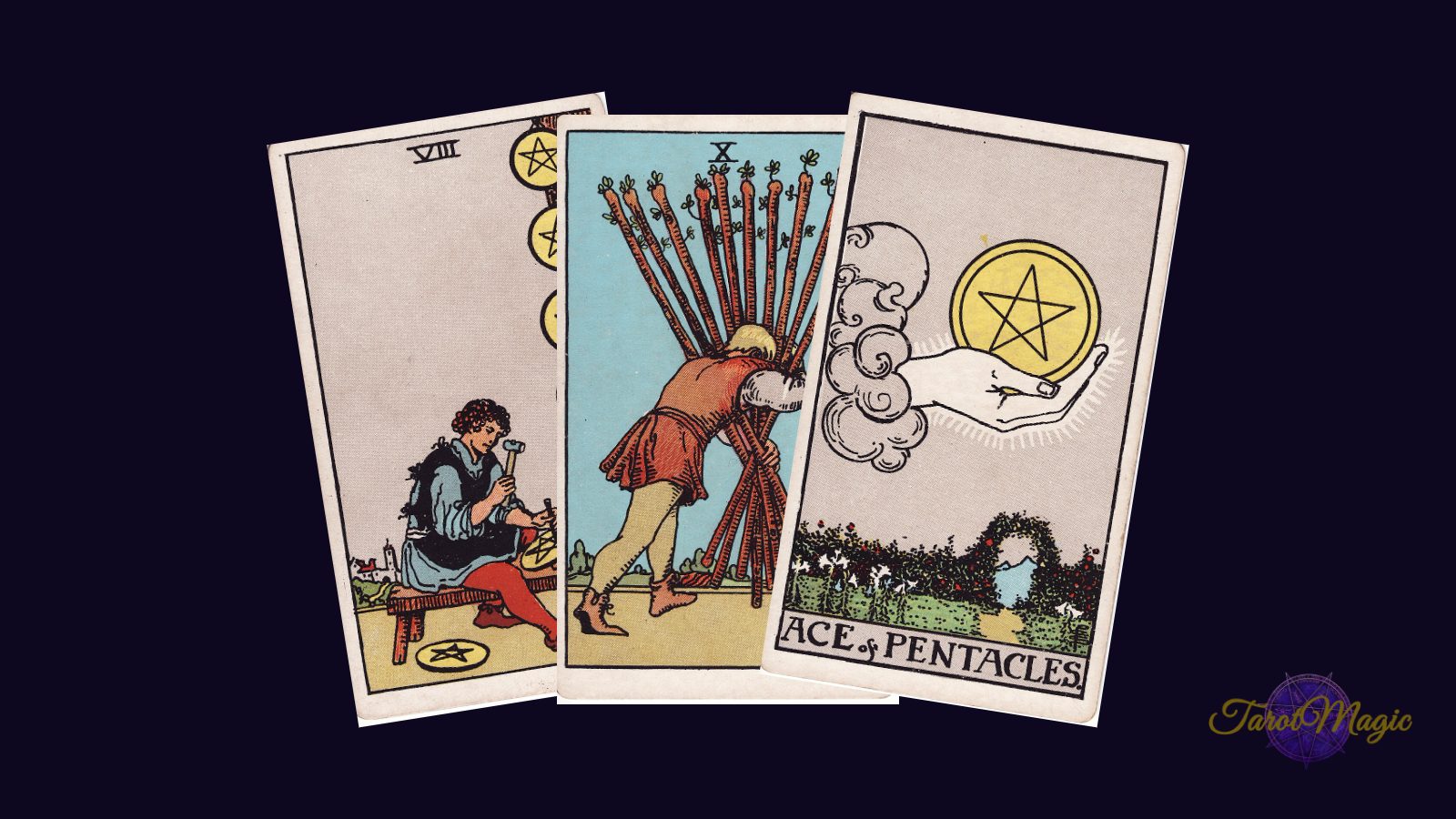
Pentacles are the suit of money and work. The Eight of Pentacles is a craftsman hammering out one coin after another. For work that's a "yes" and honest effort: you're growing in your field, even if nobody sees it yet. The Three of Pentacles is teamwork, when your part finally gets noticed. The Ace of Pentacles is a new offer or the first paycheck at a new place.
The King of Pentacles often shows up as the boss or a client: a conservative person with money who wants results, not pretty words. The Knight of Pentacles means slow but steady. The promotion is coming, just not this quarter.
Heavy cards turn up regularly too, and there's no need to fear them.
The Ten of Wands shows someone hauling an armful of sticks, unable to see the road. The classic burnout card. In a yes or no reading it means "no", and in a work spread it says it plainly: you've taken on more than you can carry, and some of it has to go.
The Five of Pentacles: two people trudging through snow past a lit window. At work this is the fear of running out of money, sometimes real, more often blown out of proportion. The card asks you to check whether there's help you're not asking for.
The Five of Swords is a conflict someone won unfairly. A coworker took credit for your idea, or your boss made a call behind your back. The card says that in a war like this, winning costs more than losing.
The Eight of Cups: a figure walking away from a row of cups into the night. If it lands in the second position of the "stay or leave" spread, you've most likely already left on the inside. All that's left is admitting it.
And the Seven of Pentacles is the eternal "maybe". A man leans on his hoe and looks at a bush full of coins: the harvest is growing, but slowly. The card's question: is it worth waiting longer, or will what you've put in never pay off?
If your spread is full of Wands, work right now is more about energy and ambition than money. More on them in our guide to the suit of Wands.
How to Read Card Combinations About Work
One card rarely tells the whole story. Watch how the cards talk to each other.
If the Ten of Wands and the Eight of Pentacles sit side by side, that's a workaholic who can no longer tell dedication from overload. They know how to work but can't stop. The advice here is usually boring and right: take a vacation before your body takes one for you.
The Ace of Pentacles next to the Four of Pentacles: there's an offer, but you're clinging to your current job and afraid to risk the stability. Ask yourself honestly what you're protecting: the salary, or the familiar commute.
And when the Chariot and the Eight of Cups land in the same spread, the decision has most likely been made already. You just needed the nerve to say it out loud.
A Job Tarot Reading, Step by Step
A question from a reader: "I've been in the same position for two years, and they keep promising a promotion 'after the project'. What should I do?" Spread: "Where Am I Now".
First card: the Nine of Wands. A tired figure with a bandaged head stands guard by a fence of staffs. How does she feel right now? Worn out and on guard, waiting for the next blow. On the site this card means "maybe" in a yes or no reading, which fits her two years of "well, maybe after the project" perfectly.
Second card: the Two of Wands. Someone holding a globe looks out from a castle wall. What isn't she seeing? That she's been eyeing other options for a while. She just won't let herself take them seriously.
Third card: The Chariot. Confident forward motion. The step now: stop waiting and take the wheel. Either a clear conversation about the promotion timeline, or an active job search.
We read it like this: first the conversation, with a specific date and number, and a résumé on the side. A month later she wrote that the promotion had been "postponed" again. By then the résumé was already out, and six weeks later she started a new job one level up. The Chariot didn't promise her boss would keep his word. It pushed her to stop sitting still.
Honestly: Don't Quit Your Job Over the Cards
Let's be blunt, since we've seen plenty of readings like this. The cards don't know the size of your savings cushion, and they can't see how many openings there are in your field right now. The Tower in a spread doesn't mean "hand in your notice today". It means something in the current setup is cracking, and it's worth admitting that.
You make the decision, with the numbers in front of you. The cards help you see what you actually want when other people's expectations are making a lot of noise. For legal questions, like a disputed dismissal or unpaid wages, you need a lawyer, not a spread.
FAQ
How often can I do a job tarot reading? On the same question, no more than once every week or two. If the situation hasn't changed, the cards will keep saying the same thing in different words.
Can I read tarot before a job interview? Yes, ideally as a yes or no question or with a single card that morning. The card of the day works well for that: it shows what to pay attention to in the conversation.
What does it mean if a work reading is all Cups? Right now the question is really about your relationships with the team. Money takes a back seat. Sometimes it means you like the job, and one specific person is the problem.
Can the cards tell me how much I'll earn? The cards don't give numbers. Pentacles show the general mood around money. No deck has salaries printed on it.
Which card is best for a new job? The Ace of Pentacles for the offer itself and the Page of Pentacles for the start: a newcomer holding a coin, ready to learn. Both mean "yes" in a yes or no reading.
Friday evening, head buzzing after a long week? Ask your question and do a three-card spread using one of the layouts above.
Read next
 Yes or No Love Tarot: 35 Questions to AskOctober 18, 2026
 What Is He Thinking About Me? An Honest Tarot SpreadSeptember 27, 2026
 Yes or No Questions to Ask Tarot: 50 IdeasOctober 11, 2026
Also useful
Readings:
- Reading → — Complete spreads for deep understanding of your situation
- Daily Card → — Discover the energy of today with your daily card
- Yes or No → — Quick answers to simple questions
- Love Tarot → — Three cards about the person on your mind
- One Card → — One card for any question — draw as many times as you like
- Tarot Birth Card → — Find your tarot card by date of birth — three methods
Knowledge:
- Card Meanings → — Complete encyclopedia of all Tarot card meanings
- Journal → — Articles on cards, spreads and tarot practice
- Learn → — A 10-lesson course: from the deck to your first spread