The Suit of Wands in Tarot: all 14 card meanings
Fire, action and the pace of events — how to read Wands in a spread and what sets them apart from the other suits
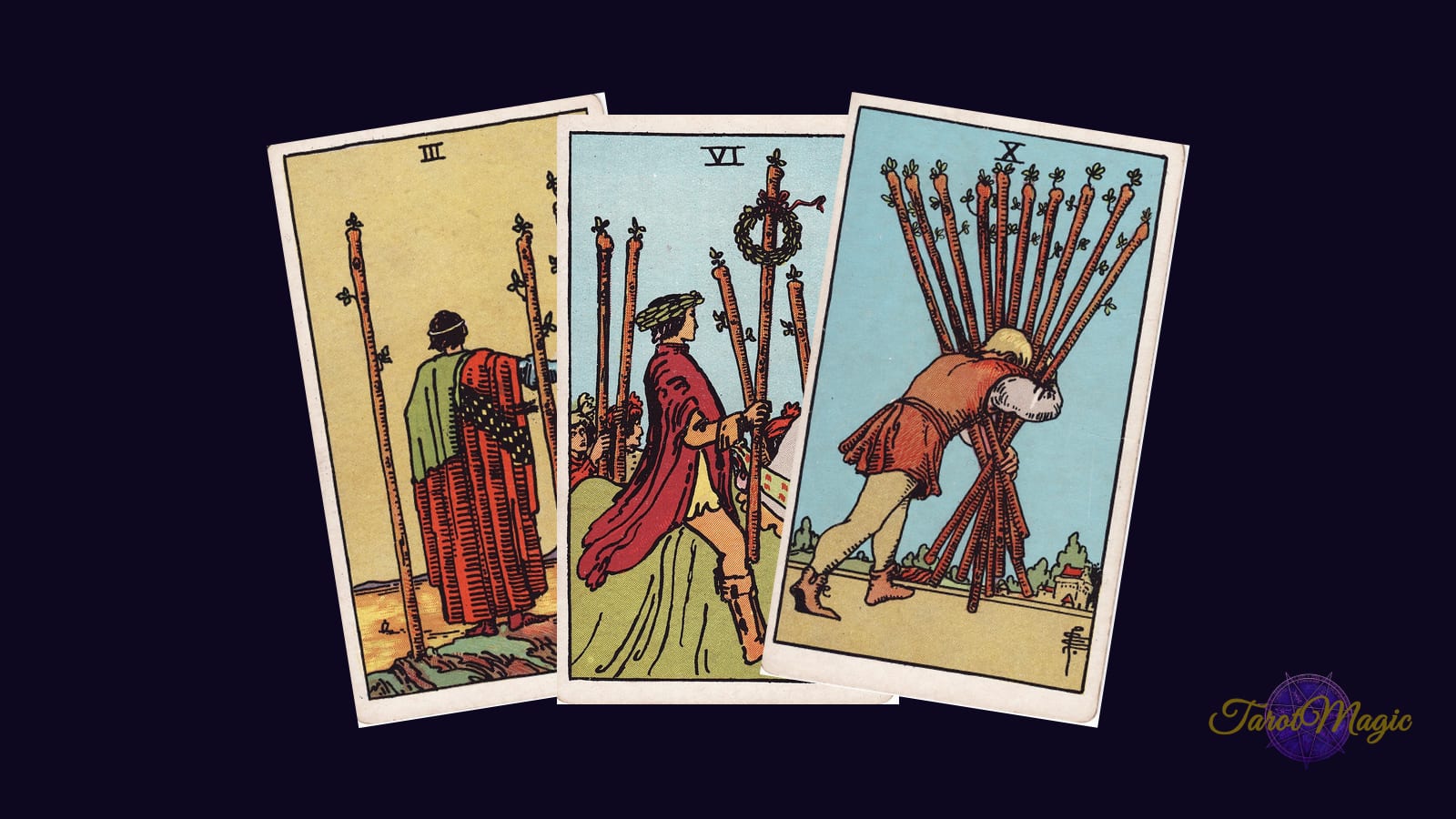
When three or four staff-bearing cards turn up in a spread, it almost always says the same thing: there is a lot of movement in your life right now. Wands are the most dynamic suit in the deck, and reading them one card at a time, without the logic of the suit behind you, loses half the meaning.
Let's go through all fourteen cards — and clear up why Wands are so often confused with Swords.
The element of Fire: what Wands actually show
Each suit of the Minor Arcana covers its own part of life. Cups are feelings, Pentacles are money and the body, Swords are thoughts and words. Wands are Fire: will, action, inspiration, work, creativity.
The key idea: Wands describe not what you feel and not what you own, but what you do and how fast it happens. That makes the suit a good answer to questions about:
- starting something — a project, a business, a venture;
- career situations that need initiative rather than patience;
- creative work and inspiration;
- timing — whether things will move quickly or drag on.
The classic beginner's mistake is mixing up Wands and Swords. The difference is simple: Swords are thoughts and words, Wands are actions. An argument where you are looking for the right words is Swords. An argument where you are already doing something about it is Wands.
The numbered Wands: Ace to Ten
The numbered cards read as the story of one undertaking: it is born, it grows, it meets resistance, and eventually it becomes a burden.
Ace of Wands — the spark. An idea that has only just appeared and has not yet lost anything. The Ace promises no outcome; it promises energy to start, and that energy is available now rather than later.
Two of Wands — the moment of choice. The figure already holds something — the world in his hand — and looks into the distance, deciding where to go. This is a card of planning, not of action: the decision has not been made yet.
Three of Wands — the ships have already sailed. The work is under way, the first results are visible, and now patience is required. The usual advice of the Three: stop poking at something that already works.
Four of Wands — celebration, home, a stable foundation. One of the warmest cards in the deck: a stage has been completed well and deserves to be marked. In relationship spreads it often points to a wedding or a move.
Five of Wands — five people clash with staves, yet nobody is hurt. This is competition without hostility: debate, rivalry, too many opinions at once. Often it describes inner confusion rather than a conflict with someone.
Six of Wands — the rider wearing a laurel wreath. Victory, recognition, the moment effort is finally seen by others. One of the best cards for questions about how something will end.
Seven of Wands — a figure on a hill fends off six staves from below. The position is strong, but holding it is your own job. This is the card of standing your ground when giving in would be easier.
Eight of Wands — eight staves flying through the air. The fastest card in the deck: news, messages, sudden acceleration. If the question was «when?», the Eight answers: soon, and abruptly.
Nine of Wands — the wounded sentry still standing. Fatigue, wariness, a path almost walked. The Nine does not tell you to push on regardless; it acknowledges that it has already been hard.
Ten of Wands — a man carrying ten staves who cannot see the road. A burden taken on voluntarily. More often than not this is a card about not delegating, rather than about an unfair fate.
The court cards: four ways of handling fire
The Wands court cards show either a person nearby or a way of behaving — possibly your own.
Page of Wands — the enthusiast. News, first attempts, the urge to try something without worrying about experience. Often marks a young person or a new interest whose shape is not yet clear.
Knight of Wands — action at full speed. Courage mixed with impulsiveness: the Knight arrives first, though not always where he meant to.
Queen of Wands — confidence that does not need to defeat anyone. Charisma, independence, warmth. In a spread she often points to a woman other people are drawn to.
King of Wands — the leader and entrepreneur. He sees the whole goal and takes others there with him. The most mature card of the suit: energy here is not wasted on fuss.
Reversed Wands: the fire does not vanish, it changes direction
Reversed, the suit usually means one of three things: there is no energy, the energy is going the wrong way, or it is being held back from outside.
- Ace reversed — an idea that was never actually started;
- Eight reversed — delays instead of speed;
- Ten reversed — a burden you finally manage to put down (one of those cards where reversed is better than upright).
Do not read a reversed card as «the opposite meaning». More often it is the same meaning turned inwards rather than outwards: not victory but self-respect without applause; not conflict but quiet irritation.
Wands in a yes or no answer
By their nature the Wands give plenty of affirmative answers: Ace, Three, Four, Six and Eight read as «yes». The Ten and the Nine lean towards «no» — or «yes, at a price». The Five and the Seven usually mean «undecided for now: it depends on whether you are willing to fight for it».
The simplest way to check a specific card is the Yes or No page, where the answer comes from the card's own data rather than from chance.
How to use this today
The best way to learn a suit is to watch it work, not to memorise it.
- Draw your card of the day and see whether a Wand comes up. If it does, recall in the evening where that energy actually showed up.
- Do a three-card spread about any work situation. If Wands dominate it, the question will be settled by doing something, not by thinking harder.
- Open the full list of card meanings whenever you want to check a particular card.
One last thing. Wands rarely say «wait». If your spread is full of them and you are still weighing things up, the answer may already be there — and only the first step is missing.
Read next
 Tarot Cards for Love: What Each One MeansOctober 4, 2026
 The Suit of Swords in Tarot: all 14 card meaningsSeptember 20, 2026
 Yes or No Love Tarot: 35 Questions to AskOctober 18, 2026
Also useful
Readings:
- Reading → — Complete spreads for deep understanding of your situation
- Daily Card → — Discover the energy of today with your daily card
- Yes or No → — Quick answers to simple questions
- Love Tarot → — Three cards about the person on your mind
- One Card → — One card for any question — draw as many times as you like
- Tarot Birth Card → — Find your tarot card by date of birth — three methods
Knowledge:
- Card Meanings → — Complete encyclopedia of all Tarot card meanings
- Journal → — Articles on cards, spreads and tarot practice
- Learn → — A 10-lesson course: from the deck to your first spread