Tarot Cards for Love: What Each One Means
The Lovers, the Two of Cups, the Queen of Cups and the rest: what each card really says about a relationship, and which ones hit the brakes
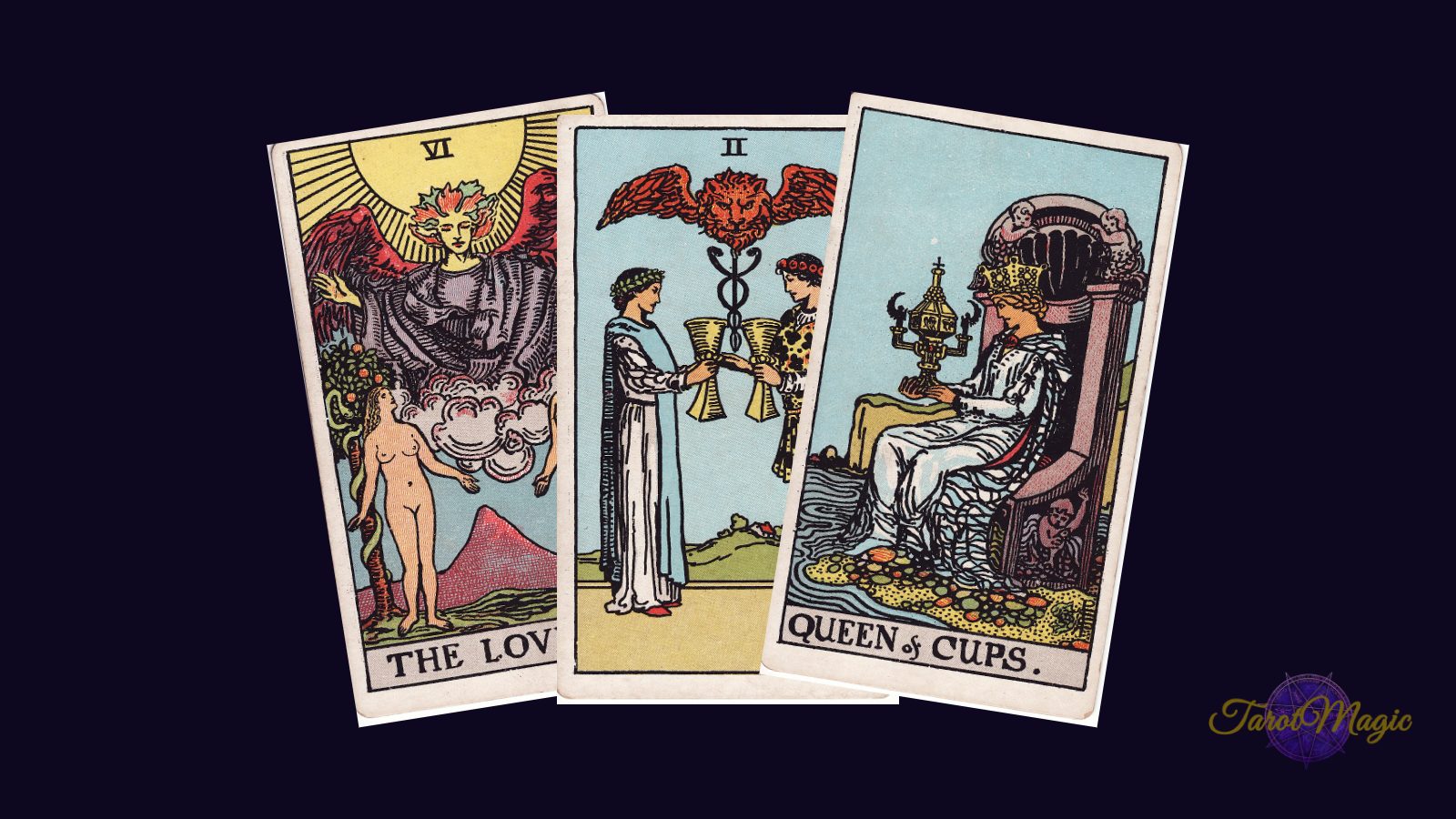
He read your message at 11:40 pm. No reply. You pull one card, then another. Then you google what the Two of Cups means "in love." Don't worry: the tarot cards for love are the ones people look up most, and it isn't close.
The trouble is that people read them one at a time, like a horoscope. But a love card next to The Star doesn't mean what it means next to The Devil. Here are the cards that really speak about love, and how they answer each other in a reading.
Which tarot cards are the love cards?
If you kept only a handful, it would be these. They come from two families: a few Major Arcana cards and nearly the whole suit of Cups, which rules emotions.
In the Tarot de Marseille, the Cups are just a pattern of goblets. In the Rider-Waite deck our site uses, every card has a scene, and that tells you far more when the question is about the heart.
The Lovers: a choice, not love at first sight
Most people assume The Lovers announces the love of your life. Sometimes it does. But look at the Marseille version: a young man standing between two women while an angel takes aim with his bow. The card is about a choice first.
In love, The Lovers says "this bond matters, and someone has to decide." If you're already together, it's often the stage where you truly commit. If you're torn between two people, the card won't choose for you. It reminds you that not choosing is a choice too.
On the yes or no tarot, The Lovers answers yes.
The Two of Cups: the couple card
Everyone hopes for this one, and for good reason. On the Two of Cups, two people raise their cups to each other, face to face, on the same level. Nobody is in charge.
In love, the Two of Cups means mutual attraction. Not a fantasy, not a one-way wait: both people feel the same thing. Early on, it often points to a first date that goes well, or a confession. In a long relationship it speaks of making up after a rough patch, of finding each other again.
A detail the handbooks skip: the Two of Cups is a card of balance. If you give everything and the other person answers once a week, the card describes what you want, not what's happening. Check the cards around it.
Reversed (if you read with a physical deck), it points to imbalance or an argument that keeps dragging on.
The Queen of Cups: loving without losing yourself
The Queen of Cups holds a closed cup and gazes at it for a long time. It's the card of intuition and tenderness. In love, it often stands for a deeply sensitive person who feels everything before anyone says it.
If she shows up for you, she's asking you to trust your gut. You already know whether this relationship is good for you. If she represents the other person, that's someone gentle who needs to feel safe before opening up.
Her trap: the Queen of Cups can give until she forgets herself. Next to the Five of Cups, she mourns what's lost instead of seeing what's left.
Her male counterpart, the King of Cups, speaks of a mature, steady love. Think of someone who stays calm when you've lost your cool.
Other love tarot cards that say yes
When these turn up in a love reading, it's good news. They all answer yes in our tool.
- The Ace of Cups: a brand-new feeling, or a love that starts over from scratch.
- The Knight of Cups: someone arriving with an offer, often a romantic one. Careful, he sometimes promises more than he delivers.
- The Ten of Cups: home and a shared life plan.
- The Empress: sensuality and the plain pleasure of being together, no scorekeeping.
- The Sun: an easy, happy relationship you don't need to hide.
Tarot cards that hold love back
Then there are the ones nobody likes to see. They answer no on our yes or no reading, which doesn't mean the story is over. They show where things are stuck.
- The Three of Swords: a betrayal, or words that hurt. Often the blow has already landed.
- The Eight of Cups: someone is leaving. Sometimes you're the one who should go.
- The Devil: an attachment that looks like love. Checking when he was last online ten times a day is The Devil.
- The Moon: fog. You don't have all the facts, so you fill the silence with your fears.
Two cards sit in between. The Hermit ("maybe" in the tool) speaks of a period alone, not necessarily an ending. The Six of Cups, also a "maybe," brings back the past: an ex texting again, or nostalgia that keeps you from moving on.
If what you really want to know is how the other person sees you, read our article on what he's thinking about you.
Example: a love reading, worked through
Emma, 31. She's been seeing Jake for three months. It's tender when they're together, but sometimes he vanishes for four days without explanation. Her question: "Where is this relationship going?"
She drew three cards: Two of Cups, The Moon, Queen of Cups.
She read them this way: the first for what connects them, the second for what's blocking them, the third for what she should do.
The Two of Cups is the good news. The attraction is mutual, Emma isn't imagining it. The Moon in the middle is the real issue: Jake's silences create fog, and Emma fills it with scenarios. She admitted she'd reread their chat three nights in a row looking for "a sign."
The Queen of Cups at the end hands control back to her. She already knows what she needs: consistency. The card doesn't say "leave him," and it doesn't say "wait." It says: trust what you feel and say it out loud.
Emma talked to Jake the following weekend. Two weeks later she wrote that he was finally replying the same day. No guarantees for what comes next, but the fog had lifted.
What the cards won't do for you
Tarot doesn't decide for another person, and it doesn't replace a conversation. It shows the dynamic as you live it, and your part in it. That's already a lot.
A tip from practice: read your spread as if you were doing it for a friend. Would you tell her to keep waiting for someone who disappears every week? Probably not.
FAQ
What is the best love card in tarot? The Two of Cups for a relationship between two people, the Ten of Cups for building a life together. The Lovers is powerful, but it talks about choice more often than quiet happiness.
Does the Two of Cups mean he loves me? It shows mutual attraction at the time of the reading. It doesn't predict a wedding, and it doesn't replace what the person tells you themselves.
Are the love cards the same in the Tarot de Marseille? For the Major Arcana, yes. The Marseille Cups have no scenes, so they're read by number and suit. The romantic meaning stays close.
Does a negative card mean it's over? No. The Three of Swords or The Moon show an obstacle. Pull a card of the day for a week and watch what keeps coming back.
Where can I read all the meanings? All 78 cards are in our card meanings section, each with its upright and reversed meaning.
Ask your question of the heart and do a free three-card tarot reading, no sign-up needed. Write the cards down, then reread them in two weeks.
Read next
 The Suit of Swords in Tarot: all 14 card meaningsSeptember 20, 2026
 The Suit of Wands in Tarot: all 14 card meaningsSeptember 13, 2026
 Yes or No Love Tarot: 35 Questions to AskOctober 18, 2026
Also useful
Readings:
- Reading → — Complete spreads for deep understanding of your situation
- Daily Card → — Discover the energy of today with your daily card
- Yes or No → — Quick answers to simple questions
- Love Tarot → — Three cards about the person on your mind
- One Card → — One card for any question — draw as many times as you like
- Tarot Birth Card → — Find your tarot card by date of birth — three methods
Knowledge:
- Card Meanings → — Complete encyclopedia of all Tarot card meanings
- Journal → — Articles on cards, spreads and tarot practice
- Learn → — A 10-lesson course: from the deck to your first spread