Two of Swords
Keywords
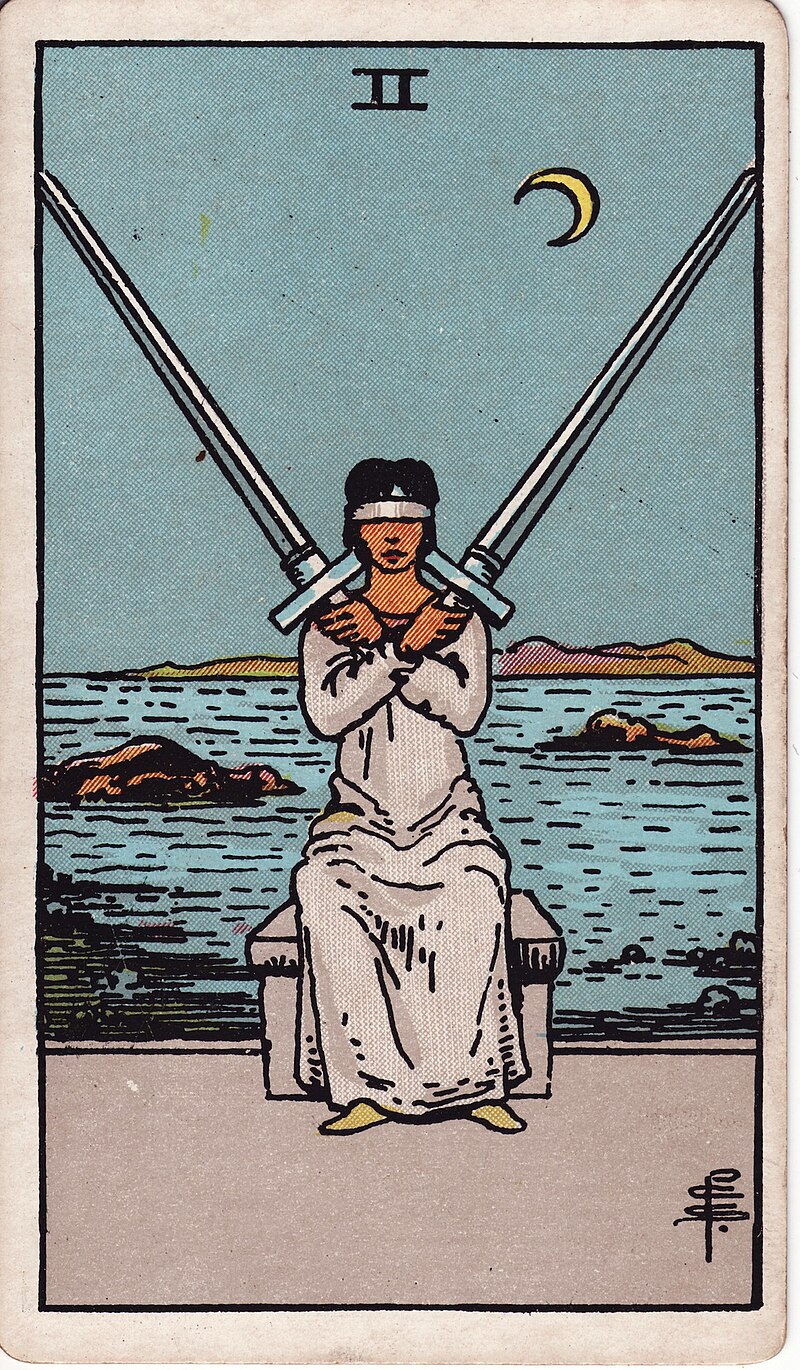
A blindfolded figure stands at fate's crossroads, balancing two gleaming swords in precarious equilibrium and infinite tension. This card unveils the paralysis of will when reason wavers between equally powerful paths, transforming choice into agonizing mystery. Its spiritual essence reveals that truth hides behind veils of ignorance, demanding an honest inner gaze to break the stalemate.
- Arcana: Minor
- Element: Air
- Numerology: 2
- Upright: MAYBE
- Reversed: NO
Upright
Difficult choice, balance, stalemate, denial. Avoiding decision.
Reversed
Information overload, indecisiveness, lying to oneself.
Card meaning by area of life
In love and relationships
In matters of the heart, this card speaks of deep uncertainty and a difficult choice ahead. If you're in a relationship, the Two of Swords points to a period when both partners stand on opposite sides of an invisible wall, neither daring to voice what truly troubles them. Communication breaks down, feelings remain hidden. For those seeking love, the card warns against trying to choose between two potential partners using logic alone. There is no clarity here, and rushing to decide serves no one. Wait for the moment when the veil lifts and your heart can hear its own voice.
In work and career
At work, this card marks the moment when you face a significant decision: take on a new project or stay in your current role, change direction or hold your ground. The choice seems balanced, both options equally appealing, which leaves you paralyzed. The Two of Swords also reveals inner conflict: perhaps you doubt your own abilities or fear making the wrong call. If you're studying, this period demands honest reflection: are you truly on the right path? The card urges you not to avoid the decision, but to look at the situation squarely, without bias.
In finances
Your financial situation has hit a standstill, caught between two poles of uncertainty. You're torn between different investments, unsure whether to spend your savings or keep them safe, whether to launch a new venture or let things be. The Two of Swords points to missing information: you lack the data needed to move forward with confidence. Risky proposals may appear, but beware hidden traps. Avoiding a choice is itself a choice, and time may slip away. The answer lies in gathering complete information, seeking counsel from those with experience, and then making a deliberate decision you can live with.
Advice of the card
You're caught in a state of paralysis, and that's understandable, but it's time to remove the blindfold. Look at your situation honestly and acknowledge what you truly know, even if it's uncomfortable. Don't pick between two paths at random. Wait until one becomes clearly closer to your heart. But don't wait passively; keep gathering information and listening to your intuition. Pay attention to what you're avoiding: often the answer lies precisely in that denial. The solution exists; it simply asks for your honesty with yourself and your willingness to act, even when uncertainty hasn't completely dissolved.
Reversed position
The reversed card shows how indecision builds up and transforms into greater chaos. In place of two clear paths emerges a flood of contradictory opinions, rumors, and information that only adds to the confusion. You begin to believe the lies you tell yourself, making excuses for your inaction. Those around you may be dishonest, or you may deceive yourself. Where the upright position still allows for stalemate, the reversed card tips into rash decisions or complete denial of the problem. What's needed now is a return to clarity: step back, silence the noise, and find the truth that lives within you.
Birth card
Only a Major Arcana card can be your birth card: your date of birth is reduced to a number from 1 to 22, and each number matches one of the 22 Major Arcana. Find yours with the tarot birth card calculator — it works it out three ways.
Is this card a yes or no?
In the upright position, the answer is MAYBE, because the card itself depicts a suspended state: the scales haven't tipped toward either side yet, and everything hinges on whether you're willing to face the truth. In the reversed position, the answer is NO — stagnation spirals into confusion and self-deception, making a favorable outcome unlikely. Much depends on how you phrase the question: if it's 'should I wait' — the answer leans toward yes; if it's 'can I solve this right now' — it's closer to no. You can put your own question to the cards in the Yes or No reading.
Frequently asked questions
What does Two of Swords mean in a tarot reading?
In a spread, this card usually signals that the question has stalled between two equally strong options, and this very stalling is what prevents things from moving forward. It rarely speaks to a concrete outcome — rather to the state you or the situation are in right now. If active cards appear nearby, the stalemate will shift soon; if passive cards surround it, the pause could drag on. Pay attention to the neighboring cards — they'll show which way the scales will tip.
Is Two of Swords a yes or no card?
The answer is MAYBE, not a straightforward yes. The card shows two options in balance, so the outcome literally hangs by a thread and depends on your decision, not external circumstances. If your question is specific, like 'will this happen without my effort,' the answer tips toward no, because nothing moves without a choice. But if you're asking about potential possibility in principle, then yes — it exists, just requires you to take action.
What does Two of Swords reversed mean?
A reversed card first signals this: it's time to stop and quit grabbing at new opinions and advice that only thicken the fog. Instead of hunting for one more hint from outside, you need to step back from other voices for a while and notice what you actually feel when no one's pushing. Often in this position it helps to write out the pros and cons of each option — that reveals where the real fear is and where there's just noise. Move slower, but with more awareness.
What does Two of Swords mean in love?
In love matters, this card often shows up as silent tension, where both partners sense the problem but postpone the conversation, hoping it'll resolve itself. If you're asking about someone specific, the card hints: before you make a move, ask yourself honestly what you're afraid of — rejection or the truth about your own feelings. For those choosing between two people, don't drag it out too long, because prolonged waiting becomes an answer in itself.
What does Two of Swords mean for career and money?
In work and money, the card usually points to a specific moment — an offer to accept or reject, or expenses you keep putting off. If you're weighing a deal or a job, the symbol suggests: you're missing information, and you shouldn't commit until the full picture becomes clear. In financial matters, it's also a sign that delaying the decision costs more than it seems, so set yourself a real deadline by which you need to decide.
Other cards of the Suit of Swords
- Ace of Swords
- Three of Swords
- Four of Swords
- Five of Swords
- Six of Swords
- Seven of Swords
- Eight of Swords
- Nine of Swords
- Ten of Swords
- Page of Swords
- Knight of Swords
- Queen of Swords
- King of Swords
Also useful
Readings:
- Reading → — Complete spreads for deep understanding of your situation
- Daily Card → — Discover the energy of today with your daily card
- Yes or No → — Quick answers to simple questions
- Love Tarot → — Three cards about the person on your mind
- One Card → — One card for any question — draw as many times as you like
- Tarot Birth Card → — Find your tarot card by date of birth — three methods
Knowledge:
- Card Meanings → — Complete encyclopedia of all Tarot card meanings
- Journal → — Articles on cards, spreads and tarot practice
- Learn → — A 10-lesson course: from the deck to your first spread