Eight of Swords
Keywords
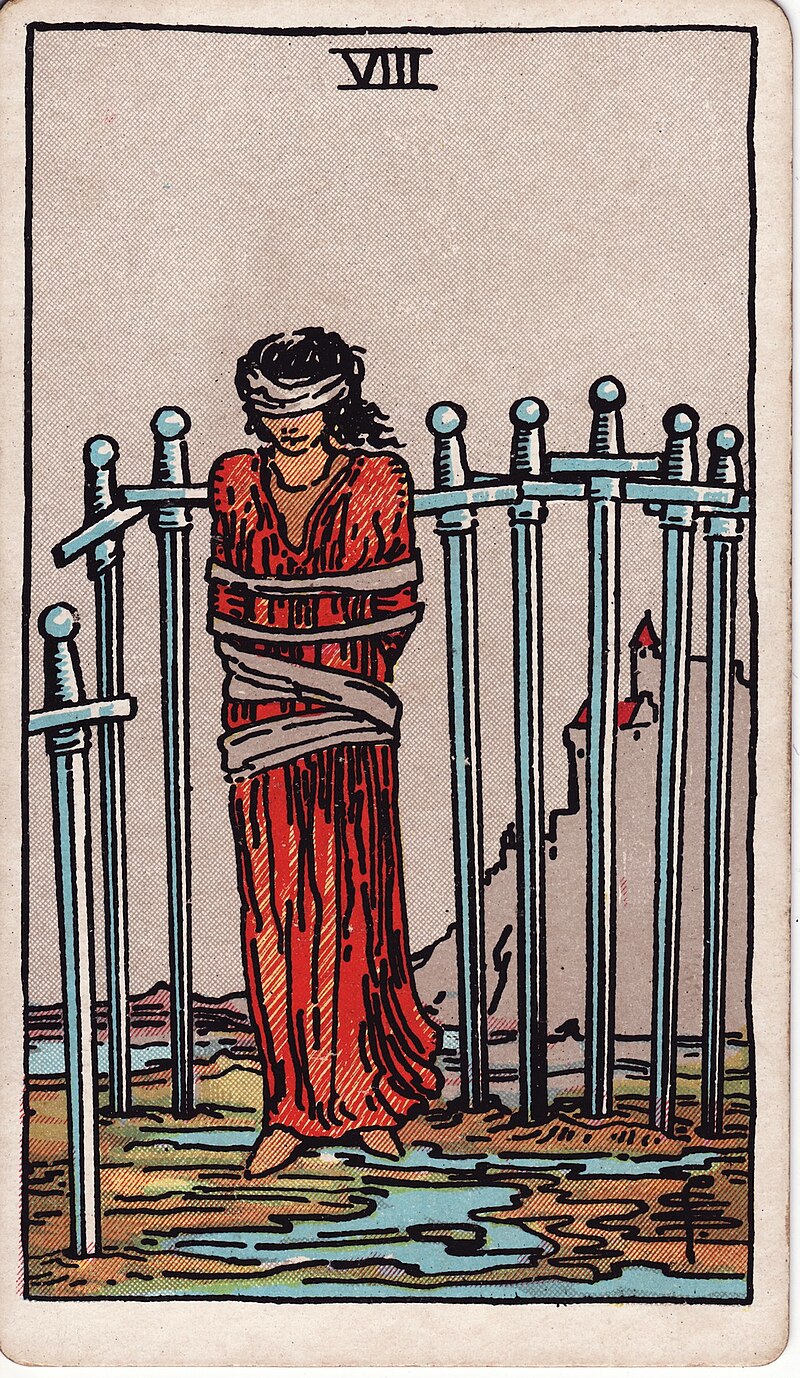
A blindfolded figure bound by eight swords embodies the illusion of captivity—chains exist only in the mind. This card reveals how thoughts become prisons where one imprisons oneself through limiting beliefs and fear. The spiritual lesson teaches that true liberation comes through recognizing these invisible bonds can be broken.
- Arcana: Minor
- Element: Air
- Numerology: 8
- Upright: NO
- Reversed: MAYBE
Upright
Restriction, isolation, trap, powerlessness. Feeling imprisoned.
Reversed
Liberation, removing blindfold, new perspectives, self-liberation.
Card meaning by area of life
In love and relationships
In relationships, this card signals stagnation and things left unsaid. If you're in a partnership, there may be an unspoken agreement to avoid discussing what matters, invisible boundaries that both partners carefully maintain. Often this stems from fear of conflict or abandonment. For single people, the card speaks of self-imposed isolation—the fear of rejection can run so deep that someone stops looking for connection altogether. Eight of Swords in love reminds you that your bonds often feel stronger than they actually are. The first step toward change is recognizing that you have more freedom than you believe.
In work and career
At work, this card manifests as a sense of powerlessness and blocked prospects. You may feel trapped in a tedious role, unable to voice your opinion or influence what's happening around you. Your boss might be pushing hard, colleagues competing, and you're afraid to take risks. In studies, the card warns against self-sabotage—when fear of failure paralyzes you more than real obstacles ever could. Yet Eight of Swords is unique: the bound figure can break free once realizing that half the chains are simply habits of thought, easier to overcome than they appear.
In finances
Financially, this card embodies a sense of material helplessness and constraint. Money seems stuck between expenses and the income you want, leaving no room to breathe. You might feel buried in debt, or simply believe your earnings are too meager to make any real difference. Often with this card, people can't see opportunities for additional income even when they exist. The danger lies in fear and limiting beliefs blocking bold decisions. Eight of Swords hints at this: shift your mindset about money first, and reality will follow.
Advice of the card
Pay attention to this: most of your chains are thoughts, not facts. You've given too much power to your fears, doubts, and other people's opinions. Ask yourself honestly—what exactly is holding you back? Often the answer surprises you with its simplicity. Start small by identifying one limiting belief and testing it. Gradually but steadily expand your boundaries. The card says you can free yourself. The help you need may not come as a miracle solution, but as support from those who believe in you more than you believe in yourself right now.
Reversed position
The reversed position marks awakening and the beginning of liberation. Where the card symbolized isolation and self-deception, now the bonds fall away—the person begins to see clearly and understands they could have left at any moment. This might come as sudden insight, a conversation that shifts everything, or simply courage built up over time. Reversed Eight of Swords brings relief: the blindfold is removed, new horizons appear sharp and clear. Yet this isn't magic but the fruit of your own awareness and action. The meaning shifts from 'I am trapped' to 'I choose freedom.' This is the moment of real turning point, when words become deeds.
Birth card
Only a Major Arcana card can be your birth card: your date of birth is reduced to a number from 1 to 22, and each number matches one of the 22 Major Arcana. Find yours with the tarot birth card calculator — it works it out three ways.
Is this card a yes or no?
In its upright position, the Eight of Swords answers NO—the card reflects a state of deadlock and fear rather than an actual external restriction. Circumstances typically allow more than they appear to, but without belief in those possibilities, nothing will shift. Reversed, the answer becomes MAYBE, since the barrier is beginning to weaken, though the outcome still depends on concrete actions. Much hinges on how the question is framed: whether it concerns inner readiness yields one answer, while asking about external chances produces something entirely different. You can put your own question to the cards in the Yes or No reading.
Frequently asked questions
What does Eight of Swords mean in a tarot reading?
In a spread, this card marks the moment when someone is stuck not by circumstances, but by their own perception of the situation. It often appears when a way out already exists—simply overlooked or rejected out of fear of making a mistake. The card rarely speaks of insurmountable external obstacles; far more often it points to inner paralysis that prevents even the smallest step forward.
Is Eight of Swords a yes or no card?
Rather no, if the card appears upright: it describes stagnation and hesitation, not favorable developments. The answer softens to maybe when the card is reversed, because a chance to break free emerges. Yet accuracy depends on the question itself: whether you're asking about your own fear or your odds of success will yield different answers, even from the same card.
What does Eight of Swords reversed mean?
The reversed card doesn't signal instant freedom, but rather the process of untangling itself—sometimes slow and with setbacks. A person begins noticing their old thought patterns, though they're not always ready to act differently in practice yet. There may be moments when freedom seems to have arrived, only for familiar fear to wash back in. This is a transition stage, not a final outcome.
What does Eight of Swords mean in love?
If the question concerns a specific choice—to stay or go, to take a step or wait—the card suggests the hesitation stems not from real obstacles but from anxiety about consequences. A partner or situation may be far more open to change than the questioner assumes. It's worth checking whether an imagined refusal is being confused with an actual one. Answers to such questions usually lie hidden in willingness to take a risk, not in circumstances.
What does Eight of Swords mean for career and money?
Should the question be framed as 'will it work' or 'should I dare'—the card hints that what's holding things back is the questioner's own indecision, not a lack of real opportunities. Often an option for action already exists, yet feels too risky or unclear. A financial or career situation may shift faster than expected once a specific step stops being postponed on account of imagined consequences.
Other cards of the Suit of Swords
- Ace of Swords
- Two of Swords
- Three of Swords
- Four of Swords
- Five of Swords
- Six of Swords
- Seven of Swords
- Nine of Swords
- Ten of Swords
- Page of Swords
- Knight of Swords
- Queen of Swords
- King of Swords
Also useful
Readings:
- Reading → — Complete spreads for deep understanding of your situation
- Daily Card → — Discover the energy of today with your daily card
- Yes or No → — Quick answers to simple questions
- Love Tarot → — Three cards about the person on your mind
- One Card → — One card for any question — draw as many times as you like
- Tarot Birth Card → — Find your tarot card by date of birth — three methods
Knowledge:
- Card Meanings → — Complete encyclopedia of all Tarot card meanings
- Journal → — Articles on cards, spreads and tarot practice
- Learn → — A 10-lesson course: from the deck to your first spread