Reversed Tarot Cards and Next Steps
Whether to read reversals, and where to go after the course
This is the last lesson of the course. If you've made it here and kept your daily card journal, you're already reading tarot rather than recalling meanings. What's left is the question almost everyone asks, reversed cards, and a word on how to read without hurting yourself.
What a reversed card is
When you shuffle, some cards get turned around, and one of them can land upside down. That's a reversed card. Readers disagree about them, and there's no single rule.
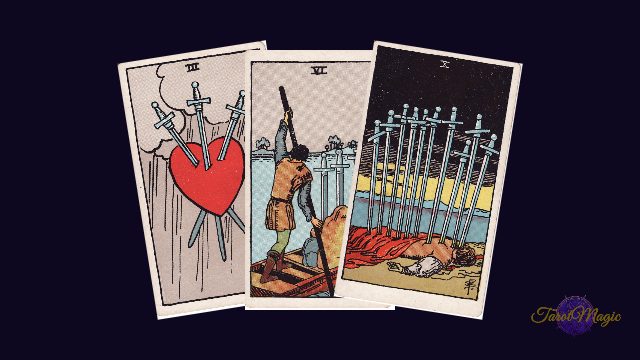
Approach one: read reversals. A reversed card then usually means the card's energy is weakened or turned inward. Interestingly, for the heavy cards the reversed meaning is often gentler than the upright one. Three of Swords upright is pain and a broken heart, reversed it's healing and forgiveness. Ten of Swords reversed is recovery after a collapse.
Approach two: don't. Many readers simply turn reversed cards upright and read them that way, taking nuance from the neighboring cards. For a beginner this is an honest option: learn the 78 upright meanings first, then add reversals.
Our online readings show every card upright, so they follow the second approach. The reversed tarot card meanings for every card are still in our tarot card meanings section, for when you want to read with your own deck.
How to read without hurting yourself
Tarot helps you look at a situation from the outside. To keep it that way, remember four rules:
- Cards don't replace a doctor or a lawyer. A reading can suggest what to think about, but decisions in those areas belong to professionals.
- No paid "curse removal." If someone asks for money after a reading to perform a ritual that "lifts a curse," it's a scam.
- Don't read on the same topic every day. If this is the third time this week you're asking about the same person, the question is no longer for the cards.
- Don't secretly read on someone to control them. Ask about yourself and your side of the relationship instead.
After the course
You know the basics. From here, practice does the rest:
- Keep up your card of the day and your journal. It's the main training tool, and it keeps working for years.
- Go deeper into the suits with our full guides to the suit of Wands and the suit of Swords.
- Do three-card readings with the layouts from lesson 9 and compare them with what happened afterwards.
- If you want to work through a hard situation with an experienced reader, the site offers a personal consultation.
Thank you for taking the course. Nobody learns tarot in a month, but you already have your first month behind you.
Take the lesson quiz → · Final course quiz →
Also useful
Readings:
- Reading → — Complete spreads for deep understanding of your situation
- Daily Card → — Discover the energy of today with your daily card
- Yes or No → — Quick answers to simple questions
- Love Tarot → — Three cards about the person on your mind
- One Card → — One card for any question — draw as many times as you like
- Tarot Birth Card → — Find your tarot card by date of birth — three methods
Knowledge:
- Card Meanings → — Complete encyclopedia of all Tarot card meanings
- Journal → — Articles on cards, spreads and tarot practice
- Learn → — A 10-lesson course: from the deck to your first spread